


Poles in Germany: Labor Migration Trends and Statistics
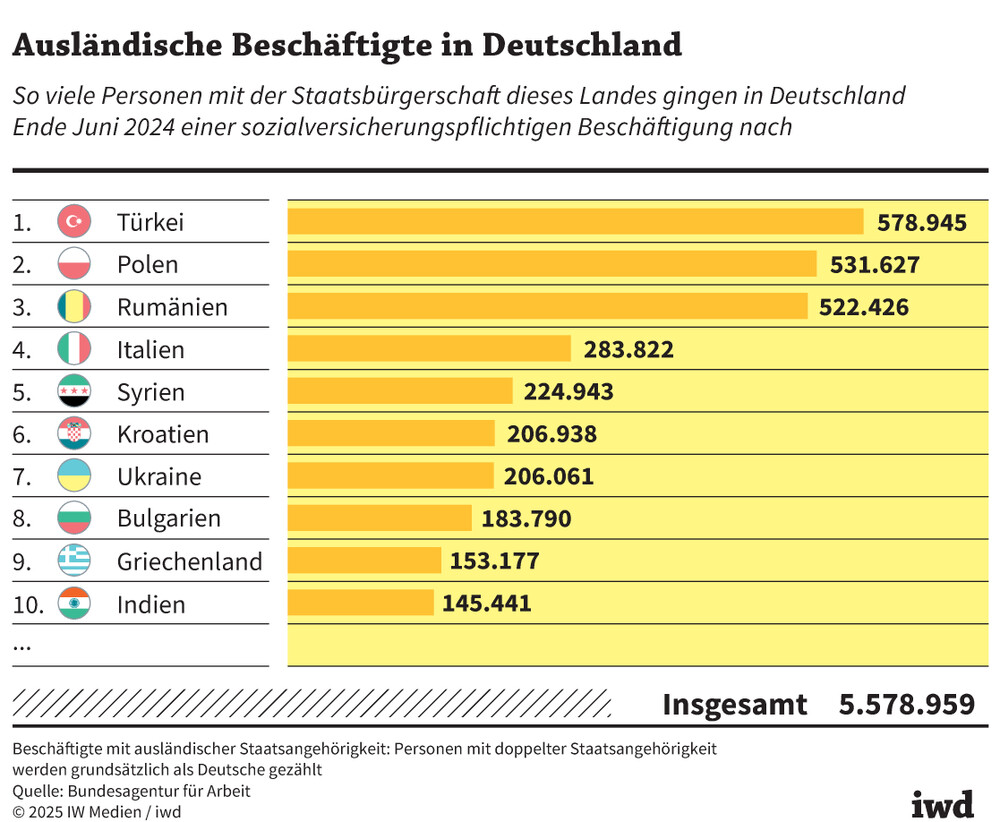
Poles in Germany: Number of Polish Workers in Germany Poles constitute one of the largest groups of foreign workers in Germany. According to data from the Federal Employment Agency, as of June 2024, approximately 532,000 people holding Polish citizenship were employed in Germany, making them the second-largest group after Turkish citizens. For comparison, in June…
Poles in Germany: Number of Polish Workers in Germany
Poles constitute one of the largest groups of foreign workers in Germany. According to data from the Federal Employment Agency, as of June 2024, approximately 532,000 people holding Polish citizenship were employed in Germany, making them the second-largest group after Turkish citizens. For comparison, in June 2019, the number of Polish workers was around 503,500, including approximately 81,000 cross-border commuters from Poland.
Historical trends indicate a steady increase in the number of Poles working in Germany, which significantly grew after the German labor market opened to new EU member states in 2011. Since then, Poles have gradually become the second-largest group of foreign workers in Germany, following Turkish nationals.
Currently, individuals with Polish passports account for approximately 9–10% of all foreign workers employed in Germany.
Poles in Germany: Sectoral Structure and Qualifications of Polish Migrants
Polish workers in Germany are primarily employed in sectors with high labor demand. The largest share of Poles works in the transport and logistics industry, particularly as truck drivers in road transport.
Other significant groups include construction workers (building and finishing trades), agriculture and horticulture, manufacturing and processing industries, as well as the food service and hospitality sector. This means that Polish labor migrants primarily fill workforce shortages in physical labor and service-related jobs – from transport and warehouse operations to construction sites, farms, and restaurants.
Regarding education levels, Poles working in Germany have relatively diverse qualifications. However, studies indicate that their overall education level is comparatively high compared to other migrant groups. For example, individuals of Polish origin are more likely to hold secondary or higher education degrees than, for instance, Turkish migrants.
Nevertheless, many Poles take up jobs below their qualification levels, often in positions that do not require advanced language skills or formal recognition of their diplomas.
Polish Wages Compared to Average Salaries in Germany
The average salaries of Poles in Germany are higher than in Poland but lower than the German national average. The median gross monthly wage for EU foreigners, including Poles, is around €2,800, while the median salary for all workers in Germany is approximately €3,650.
This means that Poles earn, on average, about 20–25% less than the national average. The wage gap is primarily due to the concentration of Polish workers in lower-paying sectors and entry-level positions. However, this difference has been gradually narrowing as labor market conditions improve and wages rise in sectors experiencing worker shortages.
German data also highlights wage differences based on qualifications: EU nationals working in low-skilled jobs earn less than their German counterparts, whereas salary gaps are smaller among highly qualified specialists.
Foreign Workers in Poland: Scale and Sectors of Employment
The opposite trend to Polish emigration to Germany is the increasing labor migration of foreigners to Poland. The number of foreign workers in Poland exceeded 1 million by the end of 2023, accounting for approximately 6.6% of the total workforce in the Polish economy. For comparison, in 2015, the number of foreign workers in Poland was six times lower.
A sharp increase occurred after 2014, particularly following the 2017 liberalization of employment procedures for Ukrainians and the 2022 influx of war refugees from Ukraine. As a result, Poland has transitioned from a country of emigration to a key destination for labor migration. By the end of 2024, approximately 1.19 million foreigners were registered in Poland’s social security system (ZUS).
Most foreign workers in Poland come from Ukraine, Belarus, and other neighboring countries, filling labor shortages due to the declining Polish workforce.
Key Sectors Employing Foreigners in Poland
The majority of foreign workers in Poland are concentrated in a few key industries, particularly those requiring industrial and service labor. According to the Polish Economic Institute (PIE), 84% of all foreign employees work in just 5–7 economic sectors.
| Economic Sector (NACE Classification) | Share of Foreign Workers |
|---|---|
| Manufacturing (Production Industry) | 20% (largest group – factories, production plants) |
| Transport & Logistics | 18% (second-largest group – road transport, warehouses) |
| Hospitality & Food Services (Hotels, Restaurants) | 12% (significant group – hotels, restaurants) |
| Construction | ~10% (estimated) (important sector – construction sites, infrastructure projects) |
| Administrative Services (Employment Agencies, Business Support Services) | ~10% (estimated) (many foreigners employed via staffing agencies and outsourcing firms) |
(Source: Polish Central Statistical Office (GUS), PIE analysis)
As shown above, foreign workers in Poland are most commonly employed in manufacturing, transport, construction, logistics, hospitality, and administrative services. In total, over four-fifths of all foreign workers are concentrated in these few sectors.
Interestingly, in industries like transport and hospitality, foreigners already make up a significant portion of the workforce – approximately 12% of all employees in these sectors are foreign nationals.
In the manufacturing sector, their share is lower (around 5%) due to a larger pool of local workers.
Conclusions and Impact on Labor Markets
The inflow of Polish workers into Germany and the increasing employment of foreigners in Poland reflect the process of filling labor shortages in both countries.
- Poles in Germany help sustain critical industries such as logistics, construction, and caregiving, often taking on roles that locals find less attractive. Their presence helps mitigate labor shortages in Germany’s aging society, although it also presents integration challenges (e.g., language barriers, diploma recognition).
- Foreign workers in Poland help offset the negative effects of Polish emigration and the declining working-age population. Thanks to Ukrainian and other foreign workers, Poland maintains economic growth and fills vacancies in industries like manufacturing, construction, and services.
These trends highlight the growing integration of the Polish and German labor markets within the EU, with labor flows moving where they are most needed. In the long term, this mobility could help balance workforce supply and demand. However, it also requires strategic migration management from governments – for example, simplifying employment procedures for foreigners in Poland and ensuring fair working conditions for migrants in Germany.
Labor migration of Poles to Germany and foreign employment in Poland have become permanent features of both labor markets, bringing benefits such as filling workforce gaps and increasing worker mobility. At the same time, these trends require ongoing monitoring to maximize positive effects (e.g., knowledge transfer, remittances) while minimizing potential social tensions and integration challenges.